A service from the
FAMILY HISTORY FEDERATION
www.familyhistoryfederation.com
www.familyhistorybooksonline.com
www.fhf-reallyuseful.com





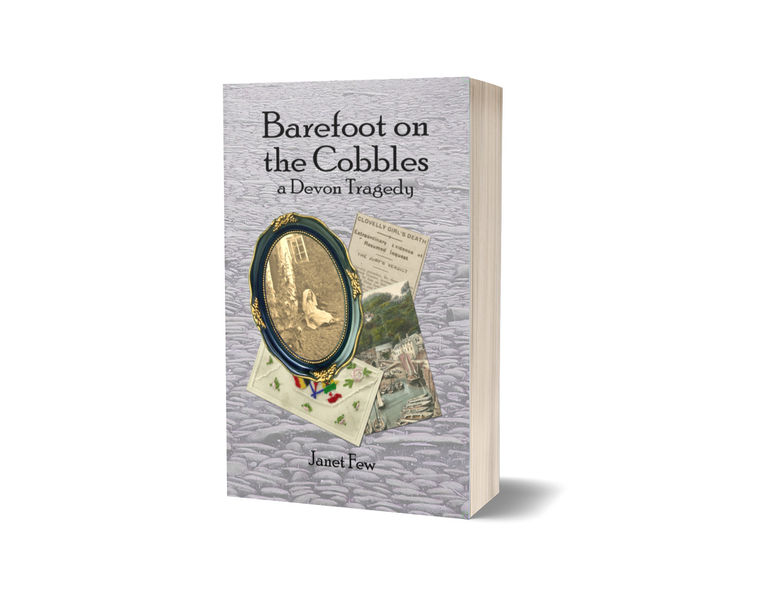
In the euphoria of the armistice a young woman lay dying. Daisy had grown up, barefoot on the cobbles, in a village on the rugged North Devon coast; she was mindful of the perils of the uncertain sea. Her family had also been exposed to the dangers of disease and the First World War but for Daisy, it was her own mother who posed the greatest threat of all. What burdens did that mother, an ordinary fisherman’s wife, carry? What past traumas had led, inexorably, to this appalling outcome?
The characters take centre-stage but the landscape through which they walk and the streets they inhabit, form an integral part of the book. The novel is rooted in the beautiful Devonshire countryside and readers will recognise the intricately portrayed setting. The characters walk the cobbled street of Clovelly, the lanes of Bucks Mills and Peppercombe and escape to the towns of Bideford and Torquay. They appear on a battlefield, in a courtroom, a workhouse, an asylum and on the hazardous waves.
Vividly recreating life at the dawning of the twentieth century, Barefoot on the Cobbles is based on a real tragedy that lay hidden for nearly one hundred years. On the surface, it is an historical novel, as it is firmly embedded in a carefully researched time period. It is emphatically not a romance, although relationships do unfold, including those between parents and children. Nor is it a crime novel, although it does involve a crime. It is certainly not a mystery, as the reader knows from the outset who has been accused. The verdict is not revealed until the end of the book and then it is up to readers to decide if the outcome was a just one.
The author refers to the story as a ‘why done it’. The book opens during a trial and then looks back to the incidents in the characters’ pasts that led them to be in that place, at that time, to become accuser or accused. This allows the novel to explore such issues as anorexia, shell-shock, mental health, alcoholism, the menopause and infant mortality. Most of the characters are ordinary people: the troubled daughter, the grieving mother, the tenacious fishermen and their anxious wives, the reluctant soldier, the gauche suitor, the shopkeepers and the servants. Then, ‘above stairs’ the reader will encounter the lady of the manor and her aristocratic guests, the gentleman’s wife who is trying to maintain an illusion of affluence, her alcoholic husband and other members of the respectable middle-classes. Readers will also meet well-known people, including the Prime Minister Herbert Asquith and three impassioned suffragettes; the keen-eyed may spot a cameo appearance by the crime writer Agatha Christie.
Here is the unfolding of a past that reverberates unhappily through the decades and reflects raw emotions that are surprisingly modern in character.